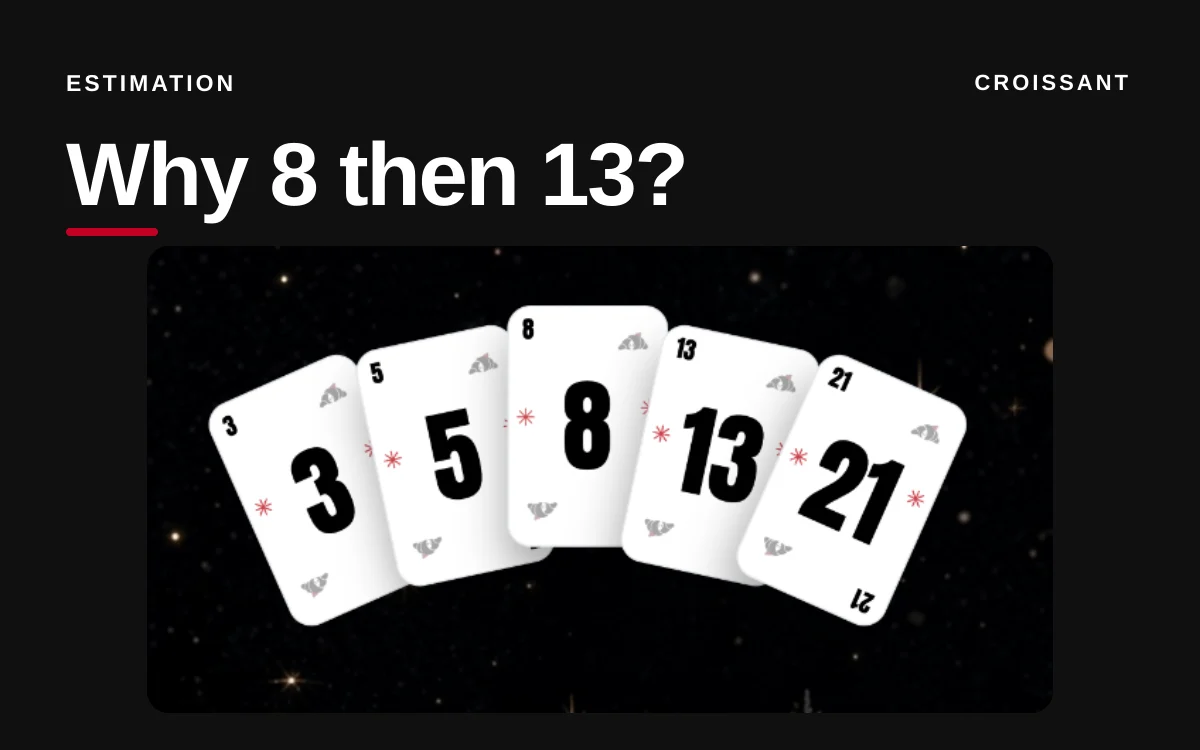
Fibonacci in Planning Poker is not a math exercise. The gaps between values force a call: the work fits one size, or it is clearly larger, without pretending you measured it to the hour. When someone hesitates between 8 and 13, it is often uncertainty or scope, not arithmetic.
This scale is a common convention, not an official rule. The Scrum Guide does not require Fibonacci. Mountain Goat Software popularised a modified sequence (0, 1, 2, 3, 5, 8, 13, 20, 40, 100). Many digital decks, including Croissant, use 21 instead of 20. The useful idea is the same: the steps get bigger as the numbers get bigger.
Why the gaps widen
A common Planning Poker deck looks like this: 0, 1, 2, 3, 5, 8, 13, 21, plus a question mark and a break card.
The useful part is not that it is Fibonacci. The useful part is that the steps get bigger as the numbers get bigger.
The difference between 2 and 3 is small. The difference between 8 and 13 is already a different kind of story. The difference between 13 and 21 is usually “we should not be estimating this as one item”.
That is the point. Small work can be told apart. Large work cannot, and the deck refuses to let you pretend otherwise with a 14.
People sometimes ask for a 10, or a 6, because the story “feels in between”. Between 8 and 13 there is no honest in-between. You either still see the edges of the work (8) or you do not (13). Inventing 10 is how a team votes on comfort instead of on size.

Uncertainty
You are not just counting tasks. You are counting how much you do not know.
A story with five clear checkboxes and a well-known service can sit at 5 even if the checkboxes take a day. A story with two checkboxes and a “we’ll have to see how the old import behaves” can sit at 13. The second one is not more typing. It is more chance of being wrong.
That is why neighbouring votes are cheap to resolve, and distant votes are not. 5 and 8: you are arguing about a corner. 8 and 21: you are not looking at the same object.
When a vote lands on “?”, treat it as a first-class result. It means “I cannot place this on the scale yet”. That is better than an 8 said with a shrug. Park, spike, or split. Do not translate “?” into 13 to keep the board clean.
What 8, 13 and 21 mean
Talk about these three as a team, once, in plain language. Write it next to the reference story.
8. We can name the work. There is some unknown, but it lives in a corner (a service we know, a case we can list). If we start tomorrow, we would not need a discovery ticket first.
13. We can name a direction, not the whole path. There is a real chance the first idea is wrong, or that another team has to move. This can still be a story, but it is the last size you should lock without a hard look at a split.
21. This is a project wearing a story’s clothes. Nobody can hold the whole thing in one explanation. Estimating it as 21 does not plan the work. It postpones the argument.
- SSO with the current provider
- Billing provider migration
- Replace the payments stack
Teams fight about 8 vs 13 because that is the last place where “story” and “too big” overlap. Use it. If the high cards are 13 and the low cards are 5, you are missing a constraint. Go back to what the 5 included, then vote again. If they stay at 13 and 21, stop. Split.
Do not lock 21 “so we have something in Jira”. Jira will survive a story that is still being cut.
When to split
Split when the scale is trying to tell you the item is not a story.
Practical tests:
- Can one person explain the outcome in two sentences without “and also”?
- Can you demo it without waiting on a second initiative?
- If the scary part failed, would the rest still be shippable?
If the answer is no, cut along the scary part. “Find out whether the provider supports this” is a story. “Switch provider” is another. Estimating them as one 21 hides a week of discovery inside a fake feature.
You do not have to split down to 1s. A backlog of tiny points is just hours in costume. Split until a 5 or an 8 is honest. Then stop.
Other scales
Fibonacci is a default, not a moral position.
T-shirt sizes (S, M, L, XL) work when the team estimates coarsely: roadmap slices, a mixed audience, or a first pass before refinement. They fail when you then convert S = 3, M = 5, L = 8 in a spreadsheet and call it velocity. You just rebuilt Fibonacci with extra steps, and lost the gaps you needed.
A short numeric scale (1, 2, 3, 5) works for a team that only ever takes small work. If nothing is ever larger than a 5, you do not need 21. Keep the gaps. Drop the unused cards.
Hours work for a solo task you already understand, this afternoon. They do not work as a team estimation language. That argument is in the story points guide.
Whatever you pick, pick it on purpose and keep it still for a while. Changing scale every sprint is how calibration dies.
When Fibonacci does not help
The scale is not helping when:
- The work is interrupt-driven (support, incidents). Pointing every ping is busywork.
- The team cannot name a reference story. You are stacking numbers on fog.
- Leadership uses the sum of 21s as a delivery contract. The scale will be gamed, then ignored.
- You are estimating other people’s work. Relative size needs a shared gut.
- Everything is a 5. The deck is decoration. Either the work is genuinely uniform, or people are avoiding the gap. Ask which.
In those cases, stop using the sequence until the team has a reference and a reason. A scale that nobody believes is worse than no scale.
If you want the gaps in the room instead of in a slide, run a round in Croissant. Use 8, 13 and 21 as conversation starters, not as scores. The number you lock should be the one you could still explain in the corridor afterwards.