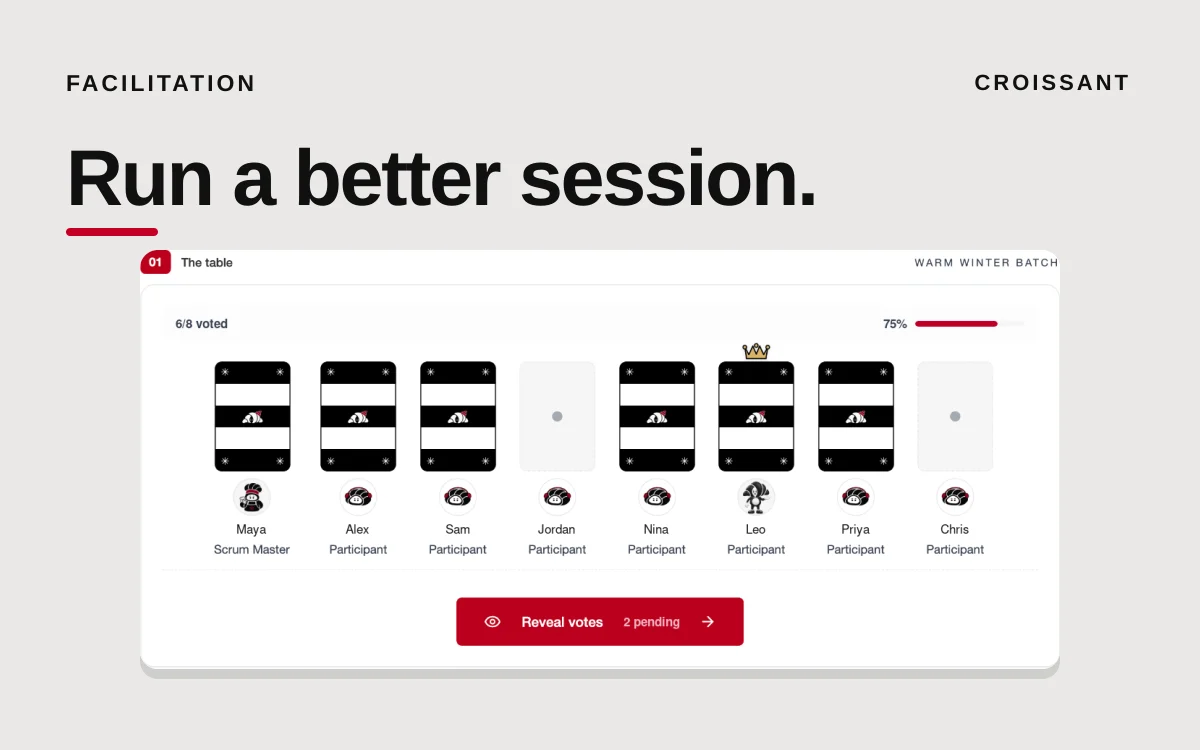
You do not need to be the most senior person in the room to facilitate. You need a backlog that is ready for a number, a few rules said out loud, and a way to stop the discussion when it stops helping. This guide walks through a typical 45-minute session.
Prepare the backlog
Facilitation starts the day before, not when the first person joins.
Walk the list you actually intend to estimate. Drop anything that still has an open product question, such as “do we even want this?”. A story that is not ready for a number will take ten minutes and produce a shrug.
For each remaining story, you should be able to say in two sentences what changes for the user and what “done” looks like. If you cannot, finish the story or split it before the session.
Order the list. Start with a story the team already understands. A messy first round sets the tone for every round after it.
Bring fewer stories than you think you can cover. A 45-minute session that finishes eight stories well is more useful than one that half-discusses fifteen.
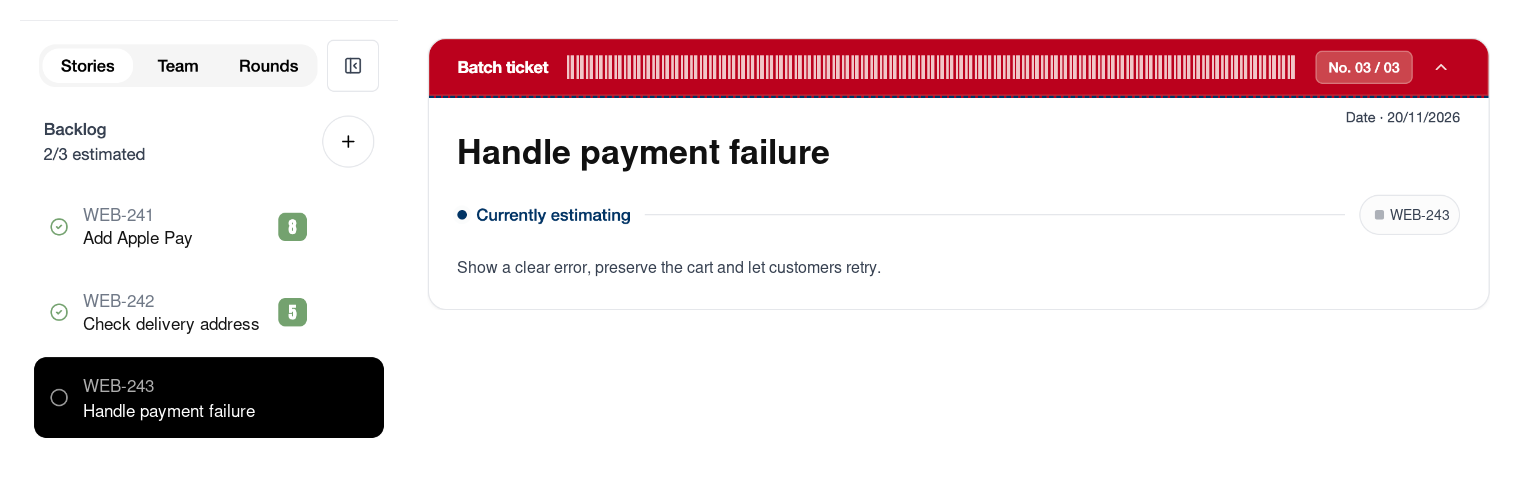
Who should attend
Invite people who will do the work or who will have to live with the result. That usually means the people who will build and review the stories, plus the person who owns the backlog. A product owner who cannot answer “is this in scope?” will stall every round.
Skip the gallery. Extra managers who “just want to listen” change the room. People vote to look reasonable instead of saying what they actually think. If someone needs to follow without voting, that is an observer. They do not hold a card.
Two people can run a session. Twelve people can also run a session, slowly. If the group is larger than the people who will actually touch the work, cut it.
How a round runs
Agree the rules out loud once, before the first story:
- Everyone who votes picks a card without talking.
- Cards stay down until you call the reveal.
- After the reveal, you talk about the spread, not about who is wrong.
- You timebox the talk. Then you vote again or you split the story.
Then run the same loop every time:
- Read the story. One person, short. Questions of clarification only, no solution design.
- Silent vote.
- Reveal together.
- If the votes sit on two neighbouring cards, pick one and move on. Neighbouring cards are not a crisis.
- If the votes are far apart, hear the low and the high. One sentence each: what they included, what they feared.
- Vote again, or split, or park the story.
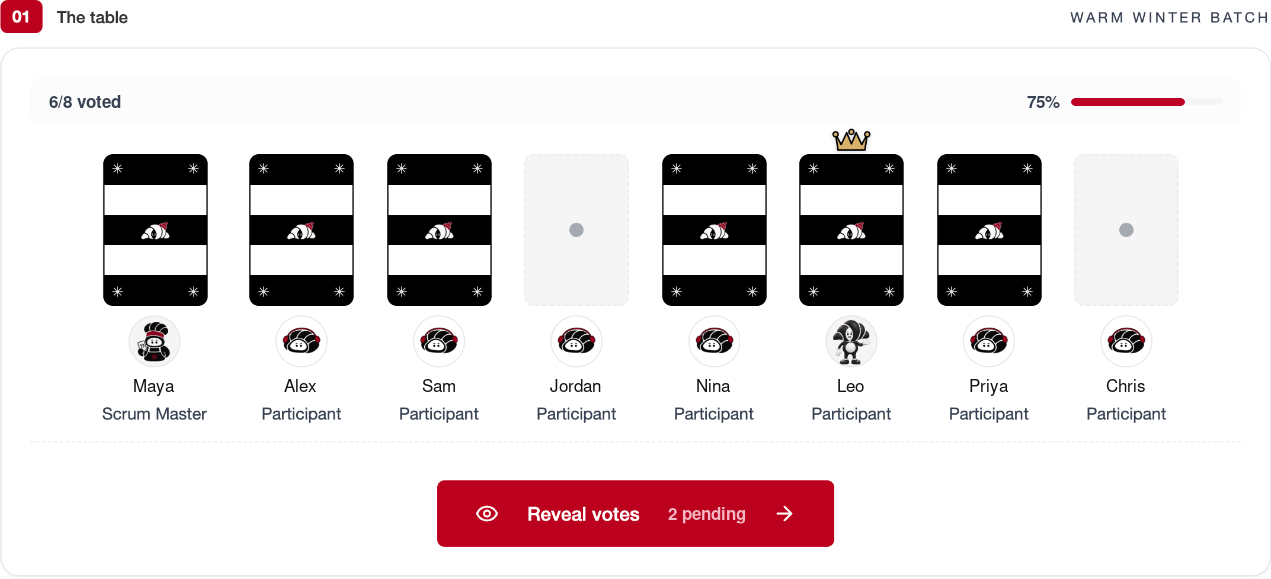
The facilitator’s job is to keep that loop intact. You are not there to have the smartest take on the story.
This sequence is a facilitation habit, not a Scrum rule. The Scrum Guide does not prescribe Planning Poker. Teams use it because hidden votes reduce anchoring: the first number said out loud tends to pull the rest of the room.
When votes are far apart
A 3 and a 13 on the same story is information. It is not a social problem.
Usually it means one of three things:
- Different scope. The 3 assumed the happy path only. The 13 assumed migrations, emails, and the admin tool.
- Different risk. Someone has been burned by this area of the codebase. Someone else has not looked at it.
- A story that is actually two stories.
Hear the 3 and the 13 before anyone in the middle talks. The middle will round the conversation toward a compromise that hides the disagreement.

Camille

Alex
Write the missing assumption on the story if it was real, for example “includes logout on every device”. Then vote again. If the second vote is still a 3 and a 13, stop estimating and split. Another ten minutes will not invent certainty.
Averaging a 3 and a 13 is a common shortcut. It hides the disagreement instead of resolving it. A team that locks 8 because 3 and 13 feel rude is not estimating. It is keeping the peace.
Timebox the discussion
Give the round a clock the room can see. Two minutes to vote and three minutes after a messy reveal is a working default. Five minutes is already long. These numbers are a facilitation choice, not a standard.
When the time is up, you need a decision: lock a neighbouring value, vote again, split, or skip. “Let’s just talk a bit more” is how a 45-minute session becomes a 90-minute architecture meeting.
If the same person fills every discussion, ask someone who has not spoken what they voted and why. Then move. Facilitation is often just making space and closing it.
Split the story
Some stories should not get a number in this session.
Signals:
- The high vote is 13 or 21 and nobody can name the work in one breath.
- The discussion keeps spawning “we’d also need to…”
- Half the room is estimating a spike and the other half is estimating the feature.
Split along the assumption you just heard. “Research whether the payment provider supports this” is a story. “Switch the provider” is another. Estimating them together is how you get 21s that mean nothing.
Parking a story is a valid outcome. Write what you still need to know, put it back on the backlog, go to the next one. A parked story is cheaper than a fake 8.
A 45-minute session
Here is a session that stays on the rails.
Before (10 minutes of your time, not the team’s). You have six stories. You dropped two that still needed a product decision. You put a familiar bug fix first.
Minute 0–3. People join. You repeat the rules in one breath. No slide deck.
Minute 3–8. First story: reset password email. Votes come back 3, 3, 5, 5. You lock 5 because the 5s included rate limiting and the 3s had not. The room now knows what a 5 feels like today.
Minute 8–18. Second story: SSO with an existing identity provider. First reveal is 5, 8, 13, 13. You ask the 5 and a 13 to speak. The 5 assumed “copy the config from the other app”. The 13 assumed a new provider, legal review, and logout everywhere. You write “same provider as storefront, no new vendor” on the story. Second vote: 5, 8, 8, 8. You lock 8.
Minute 18–28. Third story is a billing migration. Reveal: 8, 13, 21. After two minutes it is clear this is a project. You split it into “inventory of current charges” and “cut over a single plan”. You estimate the inventory at 5. You leave the cutover for a later session.
Minute 28–40. Two small stories, neighbouring votes, locked without speeches.
Minute 40–45. You stop, even though one story is left. You say what was locked, what was split, what is parked. The meeting ends on time.
That is a good session. Not because every number was “right”, but because the team still has a shared picture of the work.
If you want a board that keeps votes hidden until you decide to reveal, start a Croissant session and use this loop as-is. The facilitation does not change. The tool just stops the “I already said 8” problem.