
Planning poker is a collaborative estimation technique. The team picks an estimate for a user story on their own, then compares the cards after a simultaneous reveal. Differences start the discussion. The goal is agreement on a relative estimate, not a single person sizing the work in hours.
Why teams use it
Relative estimation compares stories to each other without pretending you already know the calendar.
Hidden votes reduce anchoring: nobody follows the first number said out loud.
When estimates differ, it often means people are not looking at the same story. That is usually when the team clarifies scope.
How a round works
A typical round looks like this:
- 1Pick the story and restate context.
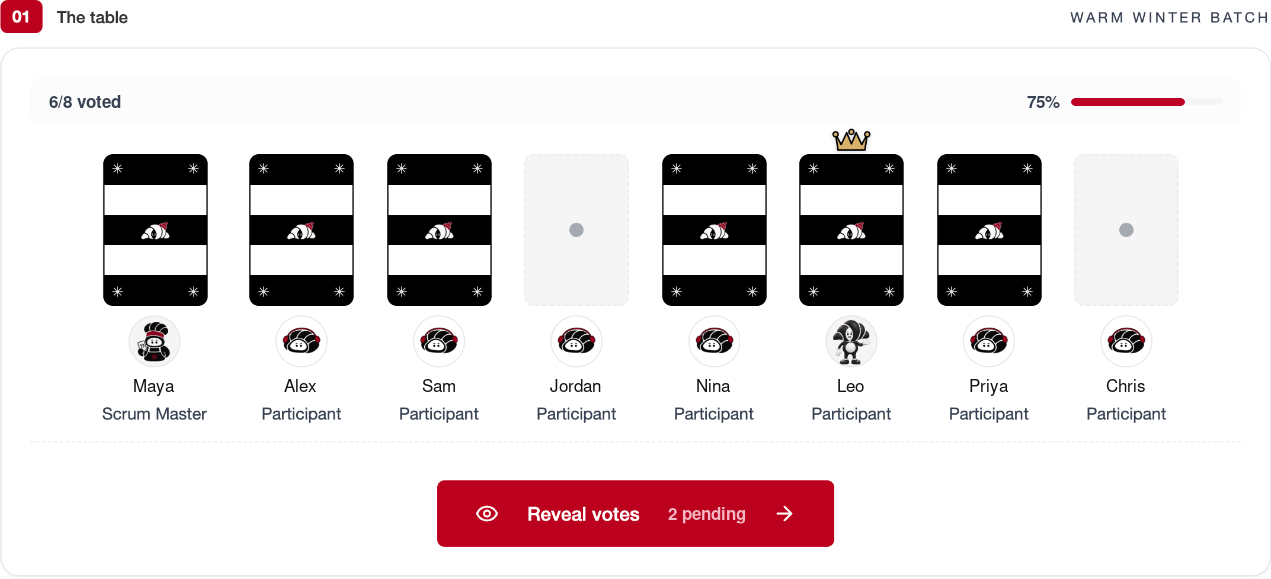
- 2Each participant chooses a card without seeing others.
- 3Reveal every card at once.
- 4If values differ, discuss risks and unknowns.
- 5Re-vote if needed, then keep the estimate the team aligns on.
Story points
Story points usually express relative complexity, effort, and uncertainty compared with other stories on the same team.
They are not a direct hour conversion: the scale belongs to the team and improves with shared delivery history.
Fibonacci and other decks
Many teams use a sequence like 1, 2, 3, 5, 8, 13, 21. Larger stories carry more uncertainty, so the gaps widen.
Fibonacci is not mandatory; some teams prefer T-shirt sizes or a short scale. What matters is a shared scale.

Planning Poker, Agile, and Scrum
You will often see it in backlog refinement, sprint prep, or planning when several people need to align on the backlog.
It is common in Agile and Scrum teams, but it is not an official Scrum rule. It is a widespread team practice for estimating together.
Points vs hours
Hours assume detailed knowledge of work and interruptions. Points let the team compare stories first and translate to duration later if that helps planning.
When it works well
Planning poker helps when the right people are in the room, the story is understood enough to discuss, and the team treats a wide spread as a signal to clarify rather than to rush a number.
Online planning poker
Remotely, a shared tool avoids counting aloud and keeps everyone on the same reveal moment.
Croissant is online planning poker: hidden votes, synchronized reveal, a story backlog, and locking estimates for teams already working in Agile or Scrum.